A guide to Twitter for researchers
A search in Google can show you a long list of academics explaining how X (formerly Twitter) has benefited their research, before and after publication.
As a researcher, here is how X can be a useful tool to you:
Connect you with other academics in your field
Source for ideas by asking questions (“crowdsourcing”)
Spread the word about the research you’re undertaking
Publicize your article, to increase downloads, citations (in time) and impact
For an example of how a topic, an active academic, and the use of social media can come together to raise the profile and impact of research, read our case study on using social media to promote your research.

How to sign up to X and create your profile
Your profile page is effectively your “shop window” so try to make it unique, something that says who you are and what you do. Your username can be your own name (e.g., @JohnSmith) or something a bit more esoteric (e.g., @mathsgenius). Remember though, if you use your own name, it may be easier for others to find you.
Use your profile to tell people about your research and experience, what you teach, and what your interests are. Link to your blog or website too, so people can explore more, and try to add a photo so people can recognize your tweets immediately on their feed.
Who should I follow on X?
Following the right people and organizations automatically personalizes your X feed (the list of posts that come up on your home page) and helps X tailor the recommendations it makes to you.
You are bound to have a list of colleagues who already use X, so you can start with these. Then think more widely. Follow people you admire, organizations you have an interest in, media outlets, and researchers working on related areas to you.
You can also use the X lists functionality to group accounts you’re interested in and create a mini feed so it’s easier to keep up to date with their latest posts.

Tips for posting about your research
Announce your published work along with a link to your article
Tag co-authors, your publisher (e.g. @tandfonline), funder and institution, and anyone else you think might be interested in your paper. For X you can post multiple times a day.Ensure your post describes the article or topic accurately
Aim to ‘edutain’ – teach them something useful in an enjoyable way. Do not use the article title as the entire social media copy. Engage with your audience by asking them questions linked to the content of the article. Posts are limited to 280 characters per post for free accounts, so be concise and to the point. For X premium accounts, you can have up to 25,000 characters per post.Include hashtags
Know the hashtags your intended audience are using, spend time doing a little research on X beforehand to find the best ones to use. This will make your post part of a bigger conversation, meaning you might reach an even wider audience for your research. If you’re attending a conference use the conference hashtag (e.g. #ScholarlySummit) to discuss ideas raised during the conference, as well as to make connections during and afterwards.Consider including a relevant and engaging image, gif or video
This will help people engage with your article, as this can make posts more appealing and encourage people to read and click. Make sure the image is copyright free before using or make sure you give credit to the artist.Engage in X conversations
Repost what you find interesting. You can do this using X’s repost or you can add some context (and interest) by adding your own comments. You can also respond to posts, giving your view but remember to always include the username of the person you’re responding to (e.g., @JohnSmith).
These are just some starter tips; you can also direct-message people, thank people if they repost you, ask questions, or set up polls.
An X success story
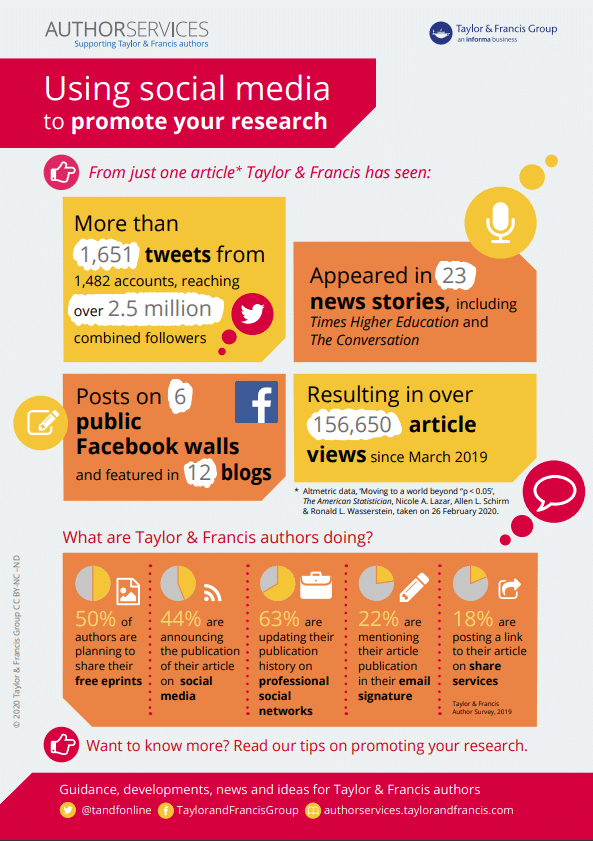
Moving to a world beyond “p < 0.05″, published in the The American Statistician is an example of one article for which using X made a difference…
Posted by 1482 accounts
1651 posts with a reach to over 2.5 million combined followers
Picked up by the Times Higher Education and The Conversation
Over 156,000 article views
The Altmetric data available on Taylor & Francis Online enables you to see the attention your article is getting including whose talking about your research on social media.
Find out more about measuring impact with Altmetric.
Further resources
A social media guide for journal editors: how to plan, grow, and maintain a journal social media account.
External resources
If you’re looking to jazz up your social media ads, we recommend visiting Canva.
Taylor & Francis Article Promotion Services will help you promote your research in an engaging way. Such as an infographic, video highlight and more.