CRediT at Taylor & Francis
Taylor & Francis is adopting Contributor Roles Taxonomy (CRediT). On this page you will discover how CRediT can benefit researchers, research institutions, funders, and publishers, the definitions of the 14 CRediT roles, and how these roles will be displayed on Taylor & Francis Online.
Please note, all authors listed on a manuscript must meet the authorship criteria as stated on this page: Defining authorship in your research paper. We use these criteria to define the term ‘author’ wherever it appears on this page.
CRediT is NOT intended to define what constitutes authorship – but instead to describe the specific contributions of the authors for a specific scholarly output.
What is CRediT?
Taylor & Francis Group is a signatory to the Declaration on Research Assessment (DORA). DORA’s vision is to advance practical and robust approaches to research assessment globally and across all scholarly disciplines. One of several initiatives that support DORA is the Contributor Roles Taxonomy (CRediT).
CRediT is a system that includes 14 roles for describing the roles and contributions of people involved in a research project. To date, this has been adopted by over 40 publishers.
For researchers – it promotes visibility and recognition. For single or multi-author papers the taxonomy provides a consistent way of capturing each author’s expertise and provides transparency for readers. For papers with a single author they should select the roles relevant to them, it is not required that they fulfil all the roles in the taxonomy.
For research institutions and funders – it gives greater access to information about how and where the researchers they support are making a difference helps to support a more holistic view of research and research evaluation.
For publishers – having more information on “who did what” provides accountability and supports research integrity and provenance checking – helping to ensure trust in research.

Individual contributors can be assigned multiple roles, and any of the 14 roles can be assigned to multiple contributors. Each named author must have at least one writing role (Writing- original draft and/or Writing – review and editing). They should also demonstrate how their contribution to the work by selecting at least one of the other 12 (non-writing) roles. Contributors who do not meet the authorship criteria can have their contributions recognised in the acknowledgments section of the manuscript.
What are CRediT roles?
For journals that have adopted CRediT, authors (or agents) creating a new submission will be able to provide the relevant contributions of each co-author from the list of 14 pre-defined contributor roles, to give each author specific credit for their work. CRediT roles must be agreed by all co-authors prior to submission. Depending on the journal, the requirement to provide CRediT roles may be optional or mandatory.
| Conceptualization | Ideas; formulation or evolution of overarching research goals and aims. |
| Data curation | Management activities to annotate (produce metadata), scrub data and maintain research data (including software code, where it is necessary for interpreting the data itself) for initial use and later re-use. |
| Formal analysis | Application of statistical, mathematical, computational, or other formal techniques to analyse or synthesize study data. |
| Funding acquisition | Acquisition of the financial support for the project leading to this publication. |
| Investigation | Conducting a research and investigation process, specifically performing the experiments, or data/evidence collection. |
| Methodology | Development or design of methodology; creation of models. |
| Project administration | Management and coordination responsibility for the research activity planning and execution. |
| Software | Programming, software development; designing computer programs; implementation of the computer code and supporting algorithms; testing of existing code components. |
| Resources | Provision of study materials, reagents, materials, patients, laboratory samples, animals, instrumentation, computing resources, or other analysis tools. |
| Supervision | Oversight and leadership responsibility for the research activity planning and execution, including mentorship external to the core team. |
| Validation | Verification, whether as a part of the activity or separate, of the overall replication/reproducibility of results/experiments and other research outputs. |
| Visualization | Preparation, creation and/or presentation of the published work, specifically visualization/data presentation. |
| Writing – original draft | Preparation, creation and/or presentation of the published work, specifically writing the initial draft (including substantive translation). |
| Writing – review & editing | Preparation, creation and/or presentation of the published work by those from the original research group, specifically critical review, commentary or revision – including pre- or post-publication stages. |
How are CRediT roles displayed on Taylor & Francis Online?

Upon publication, the CRediT roles will be visible within the author-name overlay box on the article page and in a contributions statement in the PDF version of the manuscript.

Single Authorship guidance
A single author submitting to a journal that requires CRediT can still make use of the taxonomy to provide transparency. They do not need to select all of the 14 roles, only those relevant to the preparation of the research article. This should include one of the writing roles, and other contribution roles as appropriate (formal analysis, investigation, methodology, validation, visualisation).
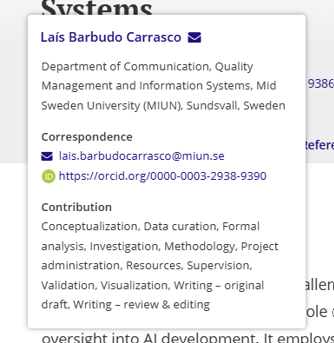
Example of CRediT roles in the overlay on Taylor & Francis Online for a single-authored paper.
Example of CRediT roles in the PDF for a single-authored paper.

Article type specific guidance
Below are some examples of different article types and the CRediT roles which may apply in each scenario. Please note this should not be used as a prescriptive list, rather it should be a guide to illustrate how authors can select relevant roles to demonstrate their contributions.
| Article type | Co-author one | Co-author two | Co-author three |
|---|---|---|---|
| Book Review (single author) | Writing original draft; Investigation; Conceptualisation; Methodology | n/a | n/a |
| Data Note (two co-authors) | Writing original draft; Conceptualisation; Methodology; data curation; validation | Writing review and editing; Conceptualisation; Data curation; Validation; project administration | n/a |
| Method (three co-authors) | Conceptualisation; Investigation; Writing original draft; Methodology; data curation; formal analysis; validation | Conceptualisation; Investigation; Writing review and editing; Methodology; data curation; formal analysis; Validation; Project administration | Conceptualisation; Investigation; Writing review and editing; Methodology; Supervision |
For journals that have not yet adopted the functionality to collect CRediT roles via the submission system, authors can use the taxonomy in their manuscript text to provide transparency on author roles. For example, see the author generated CRediT statement on this article . Please note this should be removed if preparing an anonymised version of an article to undergo double-anonymised peer review.
If you have questions about the CRediT taxonomy, please contact the Open Research team.