Creating a podcast for your research
Introduce your research in your own words
What is a podcast article?
A podcast article is an audio recording that helps researchers and academics learn about new studies. These podcasts go through the same peer review process as written articles, where experts check the quality before publication. You can submit a podcast in two ways: as a complete article by itself, or as an audio version that goes with a written manuscript.
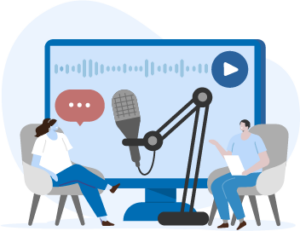
The podcast can cover any research topic that fits within the scope of the journal, such as interviews with researchers, patients sharing their treatment experiences, clinical trial protocols or research.
The podcast should match the type of article it represents. All podcast articles are published open access with a written transcript to help people find and access the content more easily, especially those who prefer reading or need text for accessibility reasons.
Publishing tips, direct to your inbox
Expert tips and guidance on getting published and maximizing the impact of your research. Register now for monthly insights direct to your inbox.
Podcasts are an interesting way to share your work with more people. Unlike written articles, they use audio format to present your message in a different way, which can make it easier for people to understand.
We can also help you with other article extenders, such as infographics, lay summaries, and graphical abstracts. For more information on the benefits of these extenders, see this Taylor & Francis abstract on ‘Evidence demonstrating how extenders increase the number of views of publications.’
When should I submit my podcast article?
For all podcasts, you’ll need to submit a discussion guide at the time of your manuscript submission. A list of submission requirements for standalone podcast articles is available further below.
The discussion guide will be peer reviewed. If peer review and the author revisions are successful, you’ll then be asked to record the podcast and provide a matching transcript for submission. If the podcast and transcript do not reflect the discussion guide or match, then further peer review or edits may be required.

How do I submit my podcast article?

You can submit your discussion guide using the journal’s submission platform.
– For standalone podcasts, submit the discussion guide as the main manuscript.
– For accompanying podcasts, upload the discussion guide as supplementary material.
– If you would like to see an example of a discussion guide, please contact the Publication Solutions Team.If you are experiencing any difficulties on the submission platform, contact the journal’s Editor so they can assist.
If you are submitting to a journal outside the Expert Medicine portfolio, please contact our Publication Solutions Team to find out which article type to submit it under.
Once submitted, contact the journal’s Editor to inform them that you have submitted a podcast article.
Tips for a good podcast
So, what makes a good podcast? Here are our top tips to think about when creating yours:
Have a good introduction
Be sure to introduce yourself and what you will be covering in the podcast. You don’t want to provide too much of your biography right away, as you want people to know what they can expect and why they should keep listening.Keep it as concise as possible
Podcasts should be no longer than 20 minutes. Making sure you have the discussion guide to hand will help you with this.Be natural
If you’re recording with another person or group of people, try to keep it as conversational as you can. Your podcast will be more effective if you speak naturally and let your enthusiasm for your work come across.Be clear and to the point
Answering these questions: what question did you want to answer with your research? How did you go about it? What conclusions did you come to? Make people want to find out more.Be accessible
Podcasts can be a great way to engage people outside your field, so use clear language and be succinct. If you restrict it to only your field you may be missing out on opportunities for cross-discipline readership, press coverage, or even influencing the work of policymakers.Be heard
Make sure your audio is clear. Pick somewhere quiet to record, as background noise can be distracting, and use a plug-in microphone.Have a call to action (for accompanying podcasts)
You want people to read your article, not just listen to your podcast, so tell them what to do once they’ve finished listening.
View examples of good podcasts
Recording your podcast
Most institutions will have digital recording devices or services, which you should be able to use. Use a recording device you are familiar with. If you use your phone or tablet, make sure it can record high definition. If you have access to one, a plug-in microphone will give you better sound quality.
The podcast file should be provided as an .mp4 file.
Submission guidelines for podcast articles
Word limit: 1500–3000 words for the transcript (excluding abstract and references)
Title: 120-character word count
Author name(s) and affiliation(s)
Abstract (maximum 200 words)
Plain language summary (optional, maximum 250 words)
Keywords (5–8)
Body of the article (provide content as discussion guide)
– Discussion guide requires 5–6 talking points with 3–5 bullet points within each talking point. If you would like to see an example, please contact [email protected]References: approximately 10 in total
Acknowledgements: author acknowledgements, including details of individuals who contributed to the article but who did not fulfil the criteria to be listed as an author (where relevant)
Disclosures: includes author contributions, relevant disclosure statements, disclosure of any writing assistance (including the funding source for this), funding information, and any other relevant disclosures.
– At the beginning of the podcast recording and transcript, authors should mention that all funding and disclosure information is available on the article homepage at Taylor & Francis Online
Publishing tips, direct to your inbox
Need some help and tips for publishing your research? Hear from expert voices, sharing top tips and advice.