Research impact
Turning research into recognized impact
Research impact is a crucial topic in the academic world, and understanding it can help you maximize the reach and influence of your work. This guide explains what research impact is, how to measure it, and offers tips for sharing your article to enhance its visibility after publication.
We don’t just publish your paper—we help it reach the right readers. We are committed to driving awareness, visibility, and discoverability of your research, giving it every opportunity to make a meaningful impact.

Impact is about looking at the effects a piece of research has had. There are many different ways your research could have an impact depending on the nature of the work.
Some key terms and areas of impact are:
Academic impact
The impact research makes in academia, for example advancing and developing understanding, methods and theory within the field or across disciplines.Cultural or societal
The impact research can have on people, culture and society.Policy
The impact of research on policy formulation, for example using research as evidence to influence policy decisions.Economic impact
Impacting businesses and economic growth or development.Environmental
Impacting the environment – for example this piece of research which explores why having awareness and knowledge about climate change is not always enough for people to behave in a pro-environmental way.Health
Such as in the development of new drugs or influencing change in medical practice.


Different organizations and funders are interested in different areas of impact, bringing together one or many of these, and possibly others. Check the definition of research impact on your institution’s website and consider which areas of impact are important to you.
In the UK, for example, the REF (Research Excellence Framework) emphasizes the cultural or societal aspect, defining impact as “an effect on, change or benefit to the economy, society, culture, public policy or services, health, the environment or quality of life, beyond academia”.
Whether you’re an early career researcher on your first journal article, or later in your career, your curious mind may change the world. Read more here to discover how to impact the world with your research.
Research impact is an important topic in the research world. Funders, institutions, and researchers themselves are all interested in assessing the quality and impact of research. Some of the different reasons why impact is important are explained in more detail below.
Research funding
Governments providing public funding strive to ensure that research of the highest quality is produced, and that research can demonstrate a clear positive contribution to society. Being able to demonstrate impact allows them to continue to justify providing funding to research in this way.
For example, the REF (Research Excellence Framework) is the UK’s system for assessing the quality of research in UK HE institutions. Impact will be worth 25% in the REF2021 assessment which is used to allocate funding of research in the UK. Find out more about the Research Excellence Framework.

Impact in research grant applications
Most funding councils and bodies ask for evidence of impact in their funding applications to help make sure that research they’re investing in delivers as many benefits as possible.
How is research impact linked to your career?
Demonstrating the impact of research can help you develop your career as a researcher, whether that be increasing your academic profile, or providing evidence of impact when applying for grants or positions that will allow you to take your career to the next step.
Some examples of impact you might explore
Communication skills you gained through presenting at a conference, or running a public engagement activity.
Project management, gained by coordinating a project with a wider team.
Using quantitative and qualitative information to make evidence-based decisions.
Impacts activities on your CV
If you’re applying for an academic position, Vitae have some useful guidance on creating an academic CV. The guidance includes ideas on how you might document impact activities on there as well as examples of CV’s from other researchers.
Research Impact Collection

We are delighted to showcase the work of expert authors, across the human, social and natural sciences, around the red hot topic of research impact.
Our global portfolio of books and journals contains countless insights into research impact, whilst increasing awareness and understanding. The collection also provides practical tips for researchers around the world.
During the writing process, there are techniques you can use to increase your research’s visibility once it’s been published, helping to drive your research impact.
Write a good title
A good title is specific and includes key words that readers might be searching for. Try to make it understandable to a reader from outside your field and, where possible, avoid abbreviations, formulae, and numbers.
Read our guide to writing titles and abstracts
Select relevant keywords
Selecting relevant keywords for your research will help others find your research quickly and accurately. Think of them as labels for your article or book. When you submit your article or manuscript proposal, you’ll be asked to provide keywords. These will be used to index your article on Taylor & Francis Online and on search engines such as Google Scholar™.
Find out more about selecting relevant keywords
Optimize your research for search engines
Selecting relevant keywords is one technique for optimizing your paper for search engines (i.e. making it more searchable online), but there are other things you can do, like including reputable external links to build connections online.

Share the results of your scientific research with policy-makers
Taylor & Francis have launched Key Policy Highlights on selected journals across the Life, Earth & Environmental Sciences. Through this scheme, authors are able to publish a secondary abstract called ‘Key Policy Highlights’, as part of the scientific research paper. This secondary abstract communicates the significance of scientific research evidence in jargon-free and clear language, to a non-scientific audience.
Find out more about Key Policy Highlights and the participating journals
Early inclusion in citation indexes for Taylor & Francis articles
This Taylor & Francis led development will increase the early discoverability of articles published in our Web of Science indexed journals.
For many journals, articles are published online before they are assigned to a particular issue and page numbers are added. This is sometimes called ‘online first’. These papers, which you’ll find in a journal’s ‘latest articles’ section on Taylor & Francis Online, can be read and cited immediately.
However, the well-known Web of Science (WoS) indexes, such as the Science Citation Index and Emerging Sources Citation Index, have not previously listed these latest articles, from any publisher, until they become part of a paginated journal issue.
Now, authors who publish with Taylor & Francis won’t have long to wait before their article appears in the WoS. This means that readers who use Web of Science to look for related research will now find these latest articles in their search results, increasing the opportunity for this work to be read and cited.

Promoting your research can help you increase your impact as a researcher. It can encourage your peers to use your work, generate greater awareness of it, and develop your professional profile and reputation.
Join an academic research sharing network

There’s a range of research sharing and networking sites out there that many researchers take advantage of to share their research and raise their profile. Some of the common ones that you might be familiar with are:
ResearchGate
Mendeley
Academia.edu
Loop
If you have a profile on any of these platforms, then add a link to your research on your profile.
Not sure which version you can post? Find out how you can share your work.
Present your work at a conference
Attending and presenting at conferences can help make other researchers more aware of your work. We’ve put together a guide for how to get the most out of academic conferences, including how to present at conferences for maximum impact.
Read our guide to academic conferences.
Speak to your librarian, use your networks
Check your institution has a copy of your book or subscription to the journal you published in. If not, recommend it for the next subscription year. Get your students reading and talking about your publications. How? Add it, or the journal it’s included in, to your course’s essential reading list.

Taylor & Francis Online (TFO)
Your article is hosted on Taylor & Francis Online, visited by millions of users each month. Optimized for search engines and indexed in major databases like Scopus and PubMed, it ensures your research is easily discoverable by scholars and practitioners worldwide. Even better, built-in sharing tools and metrics make it simple for readers to engage with and cite your work.
New content alerts
Every journal on Taylor & Francis Online offers new content alerts, enabling readers to subscribe directly from the journal’s homepage. When users sign up for these alerts, they receive notifications whenever new articles or issues are published, including your work. This means your research is delivered directly to an audience that has actively expressed interest in the journal and its subject area, increasing the visibility of your article among highly engaged and relevant readers.
Enhanced article promotion
If you’d like to take some additional steps to cater your research toward a specific audience, we also offer optional paid professional promotional services. These include professional infographics, video abstracts, and plain language summaries. These formats present your research in a way that resonates with non-specialist audiences, such as policymakers or the media. This enhanced promotion option is particularly help for those wishing to extend their article’s visibility beyond academia. Find out more about our promotional services.
Open access funding options: Through our partnerships with global institutions and funding organizations, we provide a range of open access funding options to help you publish your work in the journal of your choice. Thanks to these open access agreements, affiliated corresponding authors can publish their research open access at no cost to themselves or benefit from discounted article publishing charges (APCs).

Explore whether your institution has an open access agreement with Taylor & Francis and discover how you can publish your research openly, ensuring it reaches the widest possible audience.
Publishing Partnerships: Publishing in a society-affiliated journal is a powerful way to boost the visibility, credibility, and impact of your research. Our partnerships with leading societies and professional associations connect your work with highly engaged audiences, from members and conference attendees to policymakers and practitioners who are actively seeking and citing new knowledge. This gives your article a strong platform to be seen, shared, and built upon.
Understanding article versions
If you’re publishing in a Taylor & Francis or Routledge journal, there are many ways you can share your work with colleagues and peers. Before sharing your article, it is important to understand the options available for different versions of your article.
Author’s Original Manuscript (AOM)
The AOM is your original manuscript (sometimes called a preprint) before you submitted it to a journal for peer review.Accepted Manuscript (AM)
The version of a journal article that has been accepted for publication in a journal.Version of Record (VoR)
A fixed version of a journal article that has been made available by a publisher, by formally and exclusively declaring the article ‘published’.
Read our guide to find out how you can share different versions of your article.

Share your eprints
All authors who publish in a subscription-based Taylor & Francis or Routledge journal will get 50 free eprints (a free online link to your article) to share with interested readers.
From sharing on social media to adding to your institutional webpage, there are lots of ways you can share your eprints to boost your article visibility.
Authored works
Authored works is our dedicated center for all authors who have published in a Taylor & Francis journal.
Authored works is where you can download the PDF or view the HTML of your article, get your free eprint link to share with friends and colleagues, check the latest download figures, and more.
To access your Authored works, simply log in to Taylor & Francis Online, select ‘Your account’ from the top menu, select ‘Account settings’ and then you’ll find Authored works as an option in the left-hand menu.

All the articles you have published on Taylor & Francis Online will be listed here, with their associated readership and citation data. You can also keep track of how many free eprints you have left, and easily post an eprint directly to X, Facebook, or LinkedIn using the social share buttons.
Open access options
We offer a range of open access options, from open research platform F1000Research to hybrid and open access journals. You can either choose to publish gold open access or make your article available via green open access options.
Find out more about publishing open access
Link between clinical trials and journal articles
If there’s a registered clinical trial associated with your research article, a Taylor & Francis Online feature makes this connection clear for readers. Using Crossref Linked Clinical Trials, a permanent link will be established between your published article and any trials it reports on.
We now share details about clinical trial registrations with PubMed and Crossref, which improves the discoverability of your work. The increased transparency also supports reproducibility of published results.
When readers click the ‘Crossmark’ logo underneath an article title, a popup lists the clinical trials relating to that article. It also includes details of other articles related to those clinical trials, helping readers discover the network of reports about the trial data you’ve used. Users of Taylor & Francis Online can find the details of trial registration, as well as any other articles associated with those trials, by clicking the Crossmark logo on the article page.

How AI is supporting research discovery and impact
Taylor & Francis recognizes the potential that AI offers for enabling expert knowledge to make its fullest possible contribution to society. Some of the opportunities we’re exploring for AI to support research impact include:
Tagging content and applying meta data automatically. This makes it easier for search engines and other discovery tools to find your article, when people are looking to read about the subject of your article.
Working with AI providers to facilitate innovation in LLMs, while protecting author rights. We believe that academic knowledge has a fundamental role to play in the improvement, relevance, and performance of AI models that are used both by researchers and the world at large. Carefully considered partnerships with AI developers have the potential to help the discovery of knowledge, impact of research and effectiveness of learning.
Licensing activities such as this are a key responsibility for research publishers and part of our ongoing commitment to ensuring authors’ ideas make the fullest possible contribution. Full protection of intellectual property rights and authors’ rights are always a priority, so there are strict boundaries attached to our new AI partnership agreements. We have contractual rules that protect authors’ rights, safeguard their content from unauthorized access or use, limit the reproduction of verbatim text, and make sure that royalties are paid to rightsholders in accordance with the licensing terms in their contracts.
As a researcher, you’ll be used to gathering facts and evidence to back up the claims you make in your work. The same is likely to be true of the work you put into improving the impact of your research.
There are a lot of metrics that can allow you to measure impact, but knowing what each one can tell you and how to interpret the data can be challenging. We’ve put together some resources to help you to use and understand these metrics, and most importantly, how to use them in combination to build a full picture of the impact your research has had.
Impact metrics
Article-level data and metrics
We provide clear, article-level data so you can track performance at a glance. Each individual article you publish will accrue data about how many times it has been downloaded, cited, and talked about or referenced outside of the traditional channels. Built-in metrics on downloads, citations, and Altmetric activity will help you understand where your article is making an impact. This offers valuable evidence you can use in grant applications, promotion cases, or in your professional profile.
Read more about article-level metrics, including the Altmetric Attention Score.
Journal-level metrics
Your work contributes to, and can benefit from, the impact potential of the journal you publish in. The impact profile of a journal might be an important consideration for you when choosing where to publish.
The journal you choose to publish in plays an important role in amplifying the impact of your research. That’s why we provide offer comprehensive journal-level metrics to show you a journal’s reach, influence and impact potential. These insights can help you decide where to publish by showing how your research fits with the journal’s goals and audience. Learn more about journal metrics .
Communicating Impact: We’ll keep you updated on key milestones for your article, including performance metrics and citation updates. This allows you to track its influence and easily share your research impact with your community. Learn more about measuring your research impact.
Book-level metrics
Your book collects citation and usage data which is displayed on taylorfrancis.com, showing how many times other researchers have referenced your work. These citation counts appear directly on your book’s page, giving visitors a quick measure of its academic influence. It’s a straightforward way to track your research impact and demonstrate your work’s value in the scholarly community.
Research communication can sometimes called ‘science communication’ too. It involves communicating your research in an engaging and understandable way to those outside of academia. But it goes beyond just communicating your final article or results, it’s about managing communication with stakeholders throughout the entire research process. As a Sense about Science guide recommends, ‘Involve the public. And involve them early’.
Why is research communication important?

Research communication is important for several reasons, not least because it’s about giving back to society and demonstrating the value of research that public funds often support.
“I think that decision makers and society in general needs to have access to what we do at a level that they can understand, and that they can connect the dots of why it is important to support the scientific and the research enterprise.”
– Gabby Silberman, Director General of the Barcelona Institute of Science and Technology
How to communicate your research
Consider your audience
Think about how to pitch your project to people coming from different backgrounds.Simplify your language
Save the elaborate language for academic papers and specialist conferences.Present your work… earlier on in the project
“While many universities encourage students to present papers at conferences only from the second year of doctoral research onwards, my experience shows that it can be beneficial at an earlier stage too.”
The winners of the Vitae 3 Minute Thesis Competition (3MT®) are researchers who have mastered the art of research communication. Read advice from previous 3MT® winners, and watch their award-winning presentations.
Despite its importance, engaging with policymakers is not straightforward and there isn’t one clear route for doing it. So, we’ve put together some tips for how you might approach it.
Tips for engaging with policy makers
Invest time to finding out who is making the policy decisions relevant to your research. Follow what they are doing on their websites, via X, go to their events (and invite them to yours!). Make sure that you are visible online so policymakers can find you.
Prepare your research in a way that is relevant to policymakers. For guidance on structuring a policy brief, use our template.
“A one-page summary, with key findings/ recommendations & top-line research context is ideal for initial comms.
Pitch your comms at an intelligent, non-specialist audience. Lose the jargon, & use bullet points, headings & charts to make it accessible & digestible.” – Sarah Foxen, Knowledge Exchange Unit, UK Parliament“So what?” What is the policy problem that your research can help to solve? Don’t tell policy makers what you want, ask them what they need.
Use your networks. Find out if your institution has an outreach officer. Contact the policy officer of your scientific society or professional association.
Understand the context of the policy. Your research will never respond to the entire policy question, so try to understand the bigger picture of the problem that your research is looking at. Be honest about limitations and caveats.
Consider adding a secondary abstract to your paper. Clearly communicate the significance of your research via Key Policy Highlights to support the uptake of your research into decision-making.
Writing a policy brief
A policy brief is a short, simple overview of your research findings, with terms and language that can be understood by non-specialists.
When is a policy brief useful?
When figuring out if a policy brief would be useful, a good question to ask yourself is, who would benefit from engaging with my research? Here are some situations where policy briefs can be beneficial.
If your research relates to a topic or policy issue that is under review, or if it is being developed by policy/decision makers.
If you want to show a non-specialist audience how your research helps with the issue or topic they’re working on.
To show that your work is realistic, credible, and relevant to a non-specialist audience.

Many of our journals now publish Key Policy Highlights or Plain Language Summaries. These are both great ways to communicate your research to a wider audience.
We also publish ‘Policy Briefs’ as an article type on our open publishing platforms: F1000Research and Routledge Open Research
Things to consider
Those working in policy often work to short timescales. They need information to be presented in a concise way, and on time, to be able to inform their decision-making process.
Policymakers are not always specialists. Be sure to present your research using terms and language that a non-specialist audience can understand.
Your expertise is valued by policymakers, but not necessarily your opinion. Aim to present your information in an impartial way, rather than advocating for a particular position.
How do you structure a policy brief?
We have created a simple template that you can download and use, to help structure your policy brief. You should keep your policy brief short, it should be a maximum of 2 pages.
The key elements to include in your brief are:
Title – make this memorable, engaging, and not too technical.
Contact details – including these will encourage interactions.
Key insights – convey the key points from your research, and summarize the elements of your research that have the most relevance to the policy issue or topic.
Research background – summarize your research and its focus. Convince your audience of the robustness of your research, and how it will help with the topic they are exploring.
Recommendations – outline possible approaches to address the problem or topic. Try and keep this as impartial as possible.
Visuals – include any visuals that may help your audience understand your research. Remember to include alt text on all visuals that you include.
References – cite your original research and be sure to include related resources and information. References reassure readers that your brief is based on robust information.

Further reading on policy briefs
Working with UK parliamentarians
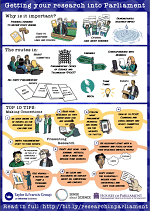
If you want to work with UK parliamentarians then read our guide, ‘Getting your research into the UK Parliament‘, featuring expert tips from POST (Parliamentary Office of Science and Technology) on how to get your research policy-ready for UK government.
There’s also a wealth of useful advice on the Research impact at UK Parliament hub.
Getting your research into European parliamentarians
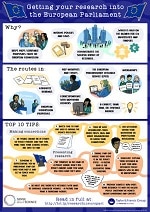
If you think your research is relevant to EU policy, then read our guide ‘Getting your research into the European Parliament’.
Different routes into the European Parliament include:
Via the EPRS (The European Parliamentary Research Service)
European Commission proposals
MEP initiatives
Intergroups
Engaging with the media is one of the best ways to raise awareness about your research to the public and policymakers.
Not all research may the grab the attention of a busy and increasingly-pressured journalist however, and some do have a better chance of piquing their interest than others.
Read our step-by-step guide which explains why and how you can work with the media to increase your research impact.

One of the biggest barriers we hear from authors who feel cautious about working with the media is they are concerned that press activity will attract criticism around their article or book.
If you (or someone you know) do become a victim of online harassment, read the updated advice from the Science Media Centre for support and tips, including how to deal with social media harassment.